 kayetana
Search by meaning, not by keywords.
Embed turns text into vectors, and rerank sorts documents by how well they match a question. That way you find the right passage even when it uses different words than your search.
What you get for your search.
Embed
Turn text into vectors in float, int8, uint8, binary and ubinary formats.
Rerank
Sort documents by relevance to a question, based on embedding similarity with bge-m3.
2D view
The Playground plots embeddings as points on a plane. Similar texts land close together.
bge-m3 for embed and rerank, ready to go.
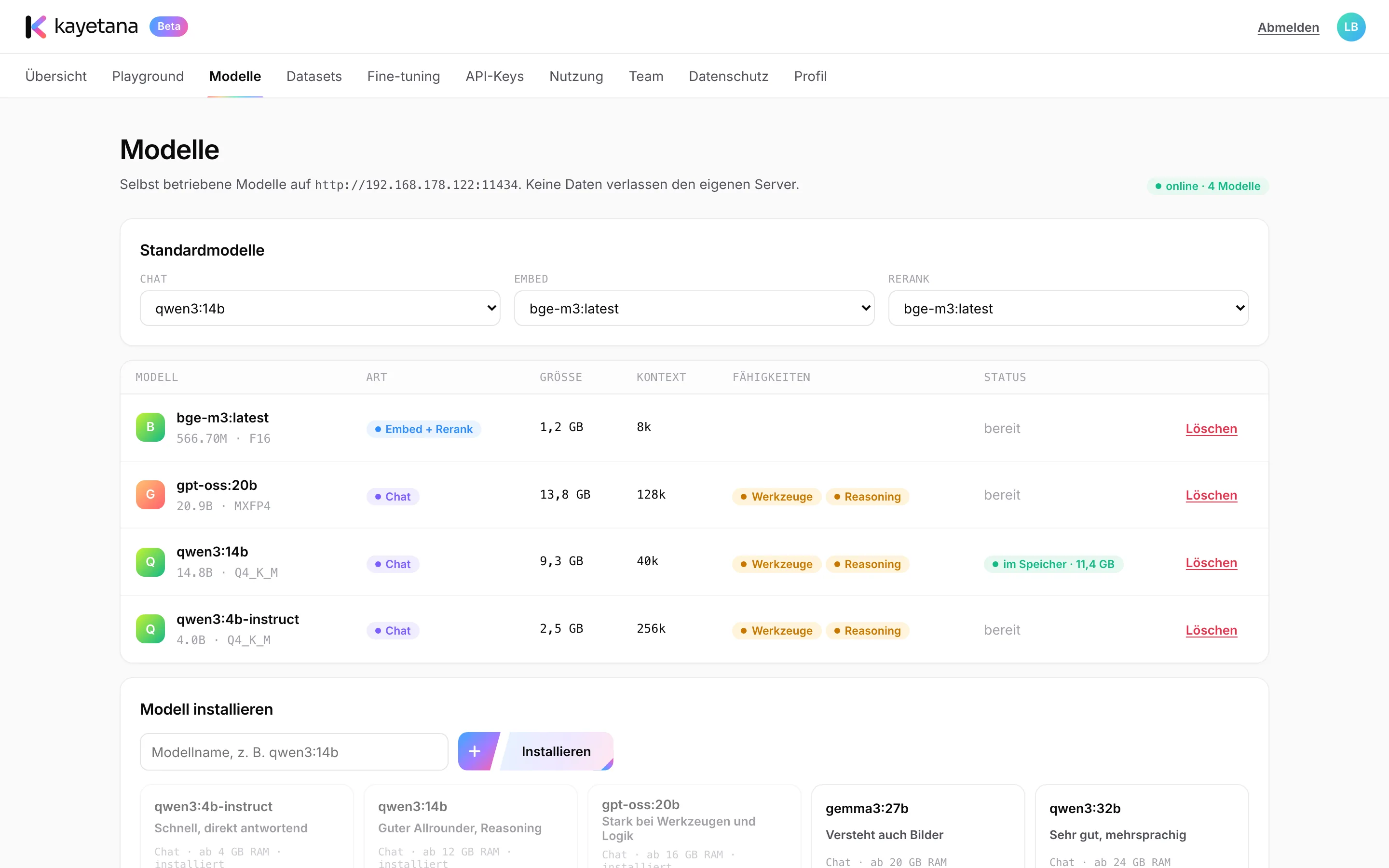
In the model list, you choose which model handles embed and rerank by default. bge-m3 comes included, and you can add other open models whenever you need them.
- A default model for each task
- Size and context length at a glance
- Add more models by name
Search across your help articles.
Embed your content
Upload your help articles as a dataset and embed them with a background embed job. You get the result as JSONL.
Embed the question
The search query from a support ticket is turned into a vector with the same model.
Find matches
Your app compares the vectors and pulls the closest articles.
Rerank
Rerank orders the matches by relevance to the question before you show them.
Where search by meaning pays off.
- Matching help articles to support tickets
- Finding similar contracts and clauses
- Spotting duplicate requests
- Suggesting boilerplate for proposals
- Making internal knowledge bases searchable
- Pre-sorting documents before an answer with sources
Find what's hiding in your text.
In a demo, we'll show you embed and rerank working with your own content.
Frequently asked questions
What's the difference between embed and rerank?
Embed turns individual texts into vectors you can store and compare. Rerank takes a question and several documents and sorts them by relevance.
Does rerank use a cross-encoder?
No. Rerank sorts by embedding similarity with bge-m3.
Which vector formats are available?
float, int8, uint8, binary and ubinary, so you can choose between full precision and more compact vectors.
How do I embed a large collection?
With an embed job. Upload a dataset, and kayetana embeds it in the background, shows the progress, and gives you the result as a JSONL download.